(1).jpg)
 (2).jpg)
.jpg)


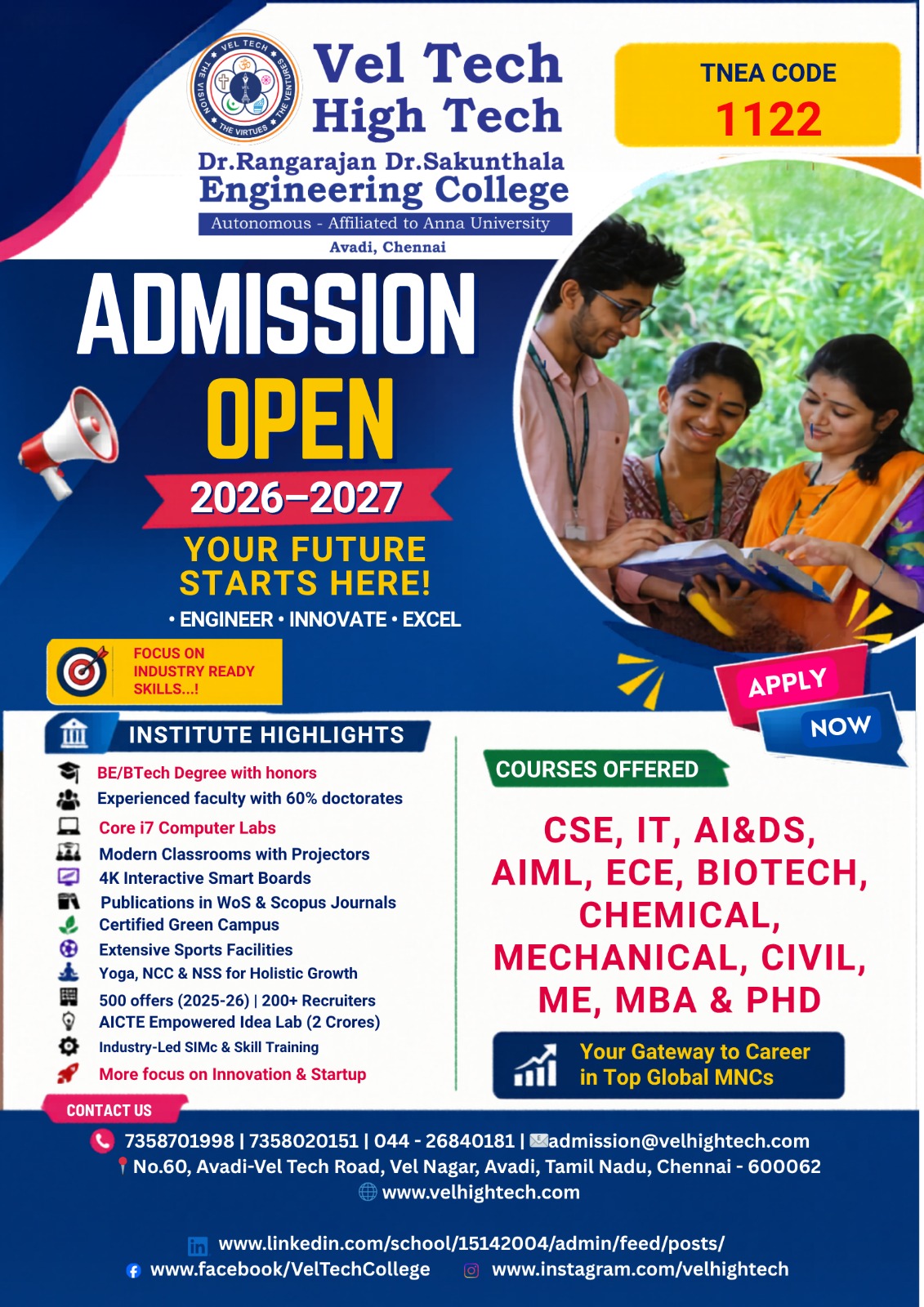
Vel Tech High Tech Dr.Rangarajan Dr.Sakunthala Engineering College (An Autonomous Institution) was established in the year 2002 under R.S.Trust, founded by the Philanthropic couple – Col. Prof. Vel. Dr. R. Rangarajan, Founder President & Chairman and Dr. Sagunthala Rangarajan, Foundress Vice-Chairman respectively. Under the governance of AICTE & Anna University, this College has 11 branches of study with 9 UG Programmes and 2 PG Programmes.
Find out more


Hear from our students about their journey and how Vel Tech High Tech helped them achieve their career goals

"Vel Tech High Tech has been the cornerstone of my growth and success. The dedicated faculty, rigorous training, and mock interviews helped me to develop the skills and confidence needed to secure a position at Infosys."
Arvindhan G IT (Infosys)
"The interactive sessions and mentorship at Vel Tech High Tech were pivotal in shaping my career. The placement cell's commitment and support helped me secure offers from TCS and Capgemini."
Kesava Prakash D J IT (TCS & Capgemini)
"Vel Tech High Tech's environment encouraged me to explore and grow. The training programs, technical guidance, and support from the placement team played a major role in helping me land my dream job at ZOHO."
Nithyanantham R IT (ZOHO)
"The placement department at Vel Tech High Tech provided excellent guidance throughout my journey. The resume-building workshops, communication training, and mock interviews helped me gain the confidence I needed."
Karthikeyan J AI&DS (Securin Inc)
"I had a great experience at Vel Tech High Tech. The training sessions were extremely helpful and focused on industry expectations. The placement team constantly supported us and valued our feedback."
Joby AI&DS (Zoho Corp)
"I thank my faculty members and placement trainers for their constant support and guidance. The training programs, mock interviews, and regular assessments gave me the confidence to face interviews."
Krishnamoorthy V Mech (Hyundai Motors)
"Vel Tech High Tech's placement training was very effective in enhancing both my technical and communication skills. The mock interviews and group discussions prepared me to face real-world interviews with ease."
Sudarshini CSE (HCLTech)
"I'm grateful to Vel Tech High Tech for providing a platform where we could learn, practice, and grow. The placement training was well-structured and addressed every aspect of the interview process."
Matheeswaran M CSE (Infosys & Capgemini)
"The college supported me throughout my academic and career journey. The placement team worked hard to provide us with the best training and opportunities. I'm happy to be placed at Capgemini."
Krithika B AI&DS (Capgemini)
"I am grateful to Vel Tech High Tech for the wonderful placement support. The resume preparation, group discussions, technical training, and mock interviews helped me secure offers from TCS, Infosys, and Capgemini."
Malaravan S CSE (TCS, Infosys & Capgemini)
"Vel Tech High Tech played a crucial role in shaping my career. The technical and soft skills training boosted my confidence. With continuous guidance from the placement cell, I got placed in Cognizant and Tech Mahindra."
Karthiyayini S IT (Cognizant & Tech Mahindra)
"Vel Tech High Tech provided me with the exposure and opportunities needed for my career. The training sessions, regular assessments, and mentoring were highly effective. I'm happy to be placed at TCS and Capgemini."
Rajesh CSE (TCS & Capgemini)
"Vel Tech High Tech has been the cornerstone of my growth and success. The dedicated faculty, rigorous training, and mock interviews helped me to develop the skills and confidence needed to secure a position at Infosys."
Arvindhan G IT (Infosys)
"The interactive sessions and mentorship at Vel Tech High Tech were pivotal in shaping my career. The placement cell's commitment and support helped me secure offers from TCS and Capgemini."
Kesava Prakash D J IT (TCS & Capgemini)
"Vel Tech High Tech's environment encouraged me to explore and grow. The training programs, technical guidance, and support from the placement team played a major role in helping me land my dream job at ZOHO."
Nithyanantham R IT (ZOHO)
"The placement department at Vel Tech High Tech provided excellent guidance throughout my journey. The resume-building workshops, communication training, and mock interviews helped me gain the confidence I needed."
Karthikeyan J AI&DS (Securin Inc)
"I had a great experience at Vel Tech High Tech. The training sessions were extremely helpful and focused on industry expectations. The placement team constantly supported us and valued our feedback."
Joby AI&DS (Zoho Corp)
"I thank my faculty members and placement trainers for their constant support and guidance. The training programs, mock interviews, and regular assessments gave me the confidence to face interviews."
Krishnamoorthy V Mech (Hyundai Motors)
"Vel Tech High Tech's placement training was very effective in enhancing both my technical and communication skills. The mock interviews and group discussions prepared me to face real-world interviews with ease."
Sudarshini CSE (HCLTech)
"I'm grateful to Vel Tech High Tech for providing a platform where we could learn, practice, and grow. The placement training was well-structured and addressed every aspect of the interview process."
Matheeswaran M CSE (Infosys & Capgemini)
"The college supported me throughout my academic and career journey. The placement team worked hard to provide us with the best training and opportunities. I'm happy to be placed at Capgemini."
Krithika B AI&DS (Capgemini)
"I am grateful to Vel Tech High Tech for the wonderful placement support. The resume preparation, group discussions, technical training, and mock interviews helped me secure offers from TCS, Infosys, and Capgemini."
Malaravan S CSE (TCS, Infosys & Capgemini)
"Vel Tech High Tech played a crucial role in shaping my career. The technical and soft skills training boosted my confidence. With continuous guidance from the placement cell, I got placed in Cognizant and Tech Mahindra."
Karthiyayini S IT (Cognizant & Tech Mahindra)
"Vel Tech High Tech provided me with the exposure and opportunities needed for my career. The training sessions, regular assessments, and mentoring were highly effective. I'm happy to be placed at TCS and Capgemini."
Rajesh CSE (TCS & Capgemini)


Maintained by VTHT Innovative IOT Club | Vel Tech High Tech, Chennai. All Rights Reserved.